
Ornamental and Mandala Tattoo Berlin: Symmetry and Meaning
Ornamental and mandala tattoos in Berlin: how symmetric patterns are built, which directions exist, which placements work and what matters for a clean result.
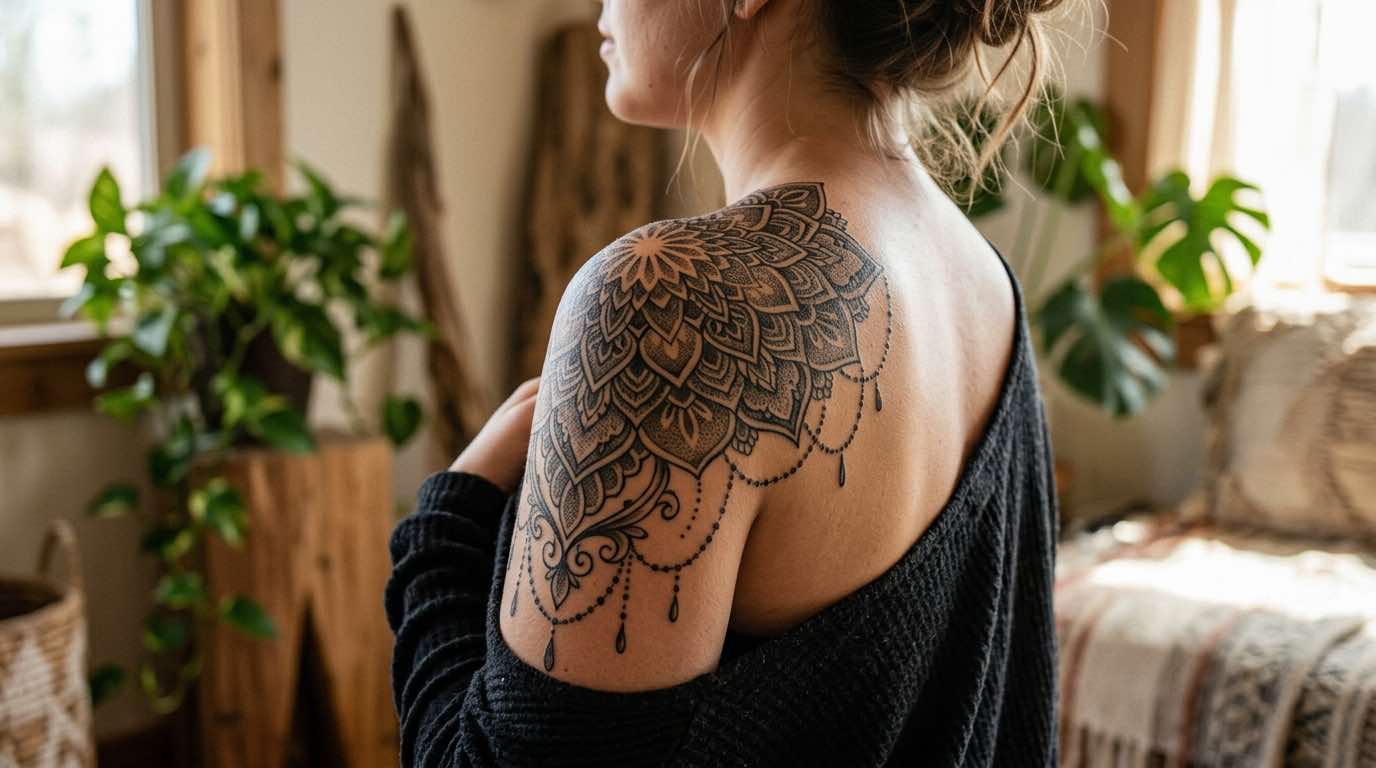
Ornamental tattoos work with patterns instead of classic picture motifs. Instead of a koi, portrait or animal, line, symmetry and repetition take centre stage, inspired by ornament, geometry and often by mandala forms. The style looks modern, elegant and timeless, but it is technically demanding because symmetry forgives almost nothing.
What ornamental means
Ornamental does not simply mean decorated. It describes its own approach: lines, dots and shapes form the whole composition, symmetry and rhythm create tension, the pattern follows the surface and flow of the body, and the colour scheme stays deliberately reduced, mostly black and sometimes with fine colour accents.
That is why ornamental work reads quiet and graphic. It emphasises the body instead of illustrating a scene, which is a large part of why the style feels timeless.
The main directions
Under the term ornamental several related styles live together: mandala with concentric circles growing out from the centre, sacred geometry with exact shapes and mathematical patterns, ornamental dotwork with dot grids for depth and texture, tribal ornament with flowing body-hugging patterns that carry cultural origin, and art nouveau with floral, curved lines.
Many patterns combine several of these elements, which is exactly where the artist's judgement matters: the pattern has to feel like one idea, not like a collection of references.
Symbolism with and without meaning
Many people choose mandalas purely for their aesthetic. In some traditions the forms carry spiritual symbolism, and that is worth knowing and respecting when you use them deliberately rather than as decoration.
Patterns without any assigned meaning are equally valid. What matters is that the composition is thought through: a good ornamental piece works as a design before it works as a symbol.
Placements and why symmetry is demanding
Symmetric, clearly visible areas work best: chest, back, upper arm, forearm and thigh, because the pattern reads cleanly there. On curved or uneven areas the design has to be adapted so it still looks straight when the body moves, and that is where ornament demands real precision.
Fine patterns also soften with age, and they lose clarity fastest on constantly moving or very thin skin. Honest advice at this point is more valuable than a design that only looks perfect on paper.
Durability, colour choice and aftercare
Four factors keep a pattern sharp over the years: size, because patterns need room so the spacing stays visible, contrast, because clear lines or accents support fine fills, placement, because arm and thigh are calmer than hand or neck, and sun protection, because UV light flattens fine structures. Black and dotwork stay stable over time, while colour accents can be combined but should be used consciously.
Aftercare follows the usual rules: do not scratch or pull scabs, use light fragrance-free care, guard fresh areas from sun. Lines and dots often look uneven during the first weeks, which is normal and evens out. Ornamental work is time-intensive because symmetry, fine lines and dot grids all consume session time, so two patterns of the same size can differ a lot in effort.
Useful next steps
Tattoo Prices Berlin
Price ranges, cost factors and budget planning for your tattoo idea.
Walk-In Tattoo Berlin
Spontaneous tattoos, suitability and the best way to plan a same-day visit.
Cover-Up Tattoo Berlin
Feasibility, limits and honest guidance for older tattoos.
Tattoo Artists
Find the right artist for style, motif and project scope.
Frequently asked questions
What is an ornamental tattoo?
An ornamental tattoo works with patterns, lines and symmetric shapes instead of classic picture motifs. It lives from repetition, rhythm and surface.
What is a mandala tattoo?
A mandala is a concentric, usually circular pattern that grows from a centre outwards. It is the best known form of ornamental and geometric tattooing.
Does a mandala need to have a meaning?
No. Many people choose mandalas purely aesthetically. In some traditions they carry spiritual symbolism, which you should know and respect if you use it deliberately.
Which placements suit ornamental tattoos?
Symmetric, clearly visible areas such as chest, back, upper arm, forearm and thigh work best, because the pattern reads cleanly there.
What does an ornamental mandala tattoo cost in Berlin?
The price depends on size, symmetry and level of detail. Very fine symmetric patterns are time-intensive, so an honest estimate before booking is worth it.