
Japanese Tattoo Berlin: Motifs, Meaning and Taboos
Japanese tattoos in Berlin: what defines Irezumi, which motif carries which meaning, how sleeves are planned and how to prepare for your appointment.
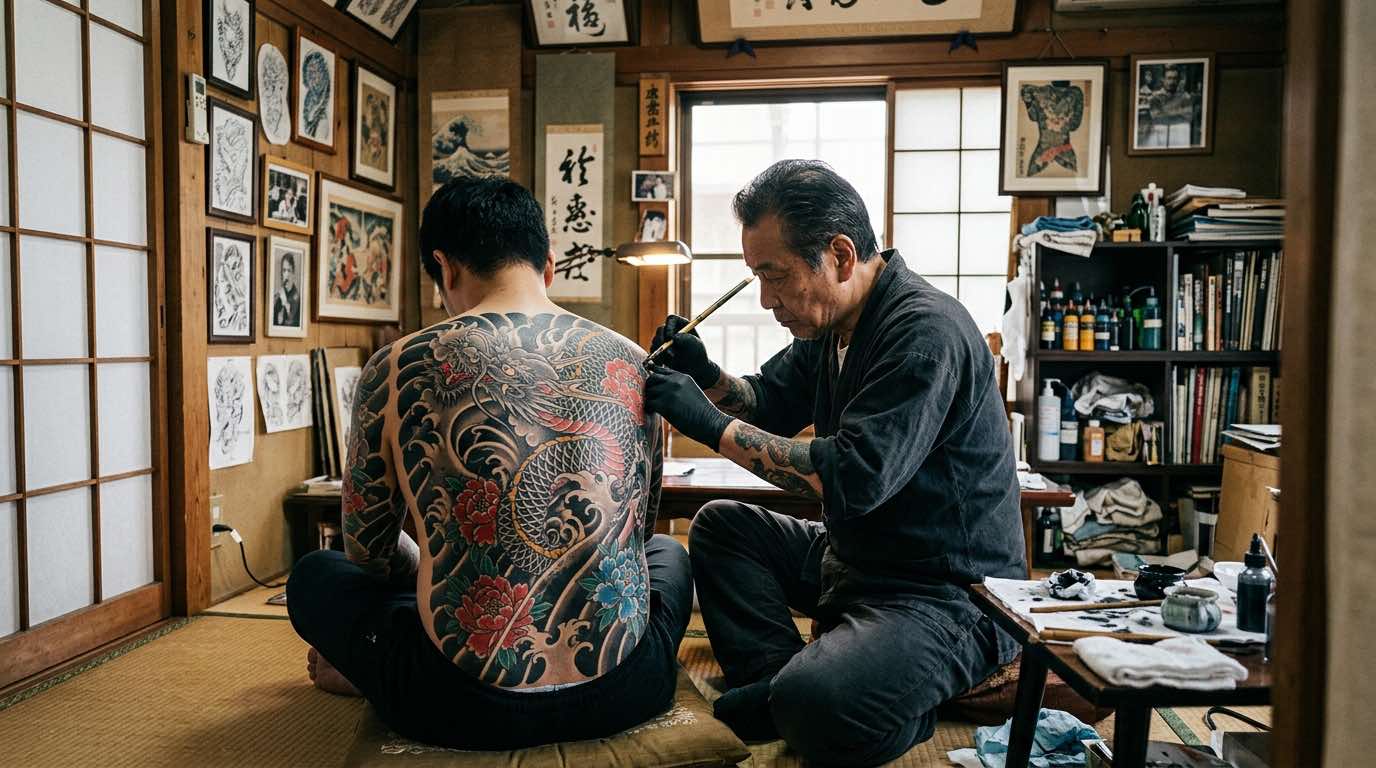
Japanese tattoos, often called Irezumi, are among the most traditional styles in tattooing. Instead of a single isolated motif, the style lives from one large connected composition in which main motif, background and body flow work together. This guide explains the defining features, motif meanings, how sleeves are planned, what to respect about the cultural roots and how to prepare for your appointment in Berlin.
What makes a Japanese tattoo
A Japanese tattoo is recognisable not by one motif but by the interaction of several features: a strong main motif such as koi, dragon or tiger, a continuous background of waves, clouds and wind bars that connects the elements, and a composition that follows the flow of the body instead of sitting flat on it.
Bold, clean lines carry the large imagery, while colour and degrees of black create volume rather than photorealism. That is why the style looks spectacular in photos and stays technically demanding at the same time: every part has to serve the whole composition.
Motifs and their meaning
Many classic motifs carry a traditional meaning in Japanese imagery. It is not rigid, but it gives direction: koi stands for perseverance and overcoming obstacles, the dragon for strength, protection and wisdom, the phoenix for rebirth and renewal, the tiger for courage and protection. The hannya mask deals with transformation and emotion, cherry blossom stands for the beauty and impermanence of the moment, and chrysanthemum motifs are often read as longevity.
These meanings also influence the composition, because a koi moving upstream is placed differently than a resting one. If meaning matters to you, say so during consultation so the direction of the piece is right from the start.
Why surface area matters and how sessions are planned
The style lives from flow, movement and background, so it needs room. Sleeves, back pieces, chest panels and large leg projects suit it best, while a small standalone motif rarely looks genuinely Japanese.
That also shapes the planning: a single motif with background on the forearm can take several hours, a half sleeve usually needs multiple sessions, and a full back piece is a project developed over months. Because of that, the cost is best planned per session rather than as one total.
Colour or black and grey
Both directions work. Colour builds depth through layered tones and stands out strongly, while black and grey stays calmer and ages extremely stably. The decision depends on your skin tone, the placement and how loud you want the piece to read in everyday life.
In both cases the background holds the composition together. Waves, clouds and wind bars are not decoration, they are the structure that allows the main motif to move.
Healing, cultural respect and judging the work
Large, wide-area work heals like any tattoo but rewards discipline: do not pull scabs or flakes, keep fresh areas out of direct sun, and pause sport, sauna and swimming for the first phase. A clear healing timeline helps you tell normal progress from an actual problem.
Irezumi has a long and partly difficult history and is deeply rooted in Japanese culture. Tattooing these motifs freely is common, but they should be chosen with respect and knowledge of their origin. When judging quality, look at the flow first: does the composition move with the body, are waves and clouds genuinely integrated into the motif, do main motif and background read clearly separated, and does the portfolio show comparably large Japanese work?
Useful next steps
Tattoo Prices Berlin
Price ranges, cost factors and budget planning for your tattoo idea.
Walk-In Tattoo Berlin
Spontaneous tattoos, suitability and the best way to plan a same-day visit.
Cover-Up Tattoo Berlin
Feasibility, limits and honest guidance for older tattoos.
Tattoo Artists
Find the right artist for style, motif and project scope.
Frequently asked questions
What is a Japanese tattoo or Irezumi?
Irezumi is the Japanese tattoo tradition. It is characterised by large connected compositions with a strong main motif and a traditional background of waves, clouds or wind bars.
Which motifs are typical for Japanese tattoos?
Koi, dragons, phoenixes, tigers, foo dogs, hannya masks, cherry blossoms and chrysanthemums, embedded in water, wind and cloud elements.
Does a Japanese tattoo need a lot of space?
Usually yes. The style lives from flow, movement and background, so sleeves, back, chest or large leg projects work best. Small standalone motifs rarely read as typically Japanese.
How many sessions does a Japanese tattoo take?
Sleeves and back pieces are almost always built over several sessions. A half forearm can be started in one appointment but is rarely finished in a single session.
What does a Japanese tattoo cost in Berlin?
The price depends on area, motif and level of detail. Because large Japanese projects run over multiple appointments, it makes sense to plan the cost per session.