Scar Cover-Up & Stretch Mark Tattoos in Berlin
Covering scars, stretch marks and surgical scars with tattoos in Berlin. Which motifs work, when laser can help, and honest consultation at Tiba Tattoo.
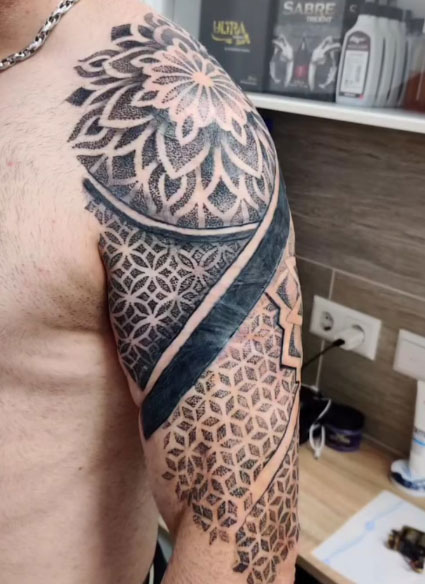
Many people search for scar cover-up in Berlin or a stretch mark tattoo — but what most do not ask out loud is this: they do not simply want 'something tattooed over it'. They want to feel free again. The story behind a scar is always personal. C-section, appendectomy, accident, burn, pregnancy, mastopexy, hernia surgery — the reasons are as different as the people. What unites them: many wish to stop seeing this part of their body as a flaw and start perceiving it as a work of art.
Scar cover-up is not the same as a normal cover-up
With a normal cover-up, you place a new tattoo over an old unwanted one. With a scar cover-up, something different is at work. You are working with changed skin structure — thicker or thinner scar tissue, uneven pigment behaviour, and areas that can take ink differently than healthy skin. Often the task is not only visual concealment but also redirection of attention and careful masking of form. And last but not least, trust. The step of showing a scar and letting someone work on it is emotional as much as technical.
That is exactly why this topic requires not only craft but also empathy and honest planning.
Which scars can really be covered well
Not every scar is immediately ready for a tattoo. And not every scar can be treated the same way. Flat, soft older scars, well-healed C-section lines after a year or more, mature accident scars, and stretch marks older than 6-12 months are usually the most suitable candidates. Thicker raised keloid or hypertrophic scars are trickier — sometimes a doctor or laser first prepares the skin.
Fresh red or pink scars, open areas, irritated zones, or sites where a dermatologist advises against tattooing should always wait. The right decision today almost always produces a better result tomorrow.
The golden rule: wait until the scar is mature
This is the mistake many people make first: they want it too fast. A scar needs time. It goes through acute healing, then remodelling, then the slow maturation phase that can take 6, 12 or in difficult cases 18-24 months. If the scar is still red, pink, swollen, or actively changing, tattooing is too early.
The good news? Waiting almost always makes the final result noticeably better.
C-section scar tattooing — one of the most common projects in Berlin
The C-section scar tattoo is one of the most frequent scar cover-up projects we see in Berlin, and for good reason. The location feels emotionally loaded for many people, the line is usually narrow and heals reasonably well after enough time, and with the right composition, it can be integrated beautifully into a design. Often it is not only about covering — it is about redesigning an emotional moment.
Strong motif directions for C-section scars include floral belt compositions, ornamental patterns, mandala-like structures, feather or butterfly designs, and fine script or lettering elements with personal meaning. The composition usually needs to extend beyond the scar itself so the result does not look like a small patch.
Stretch marks — what actually works
Striae, or stretch marks after pregnancy or weight change, are a different skin type than a classic surgical scar, but the emotional motivation is often the same. They work best once the older striae are no longer red or purple and the skin has stabilised. Floral and botanical patterns, dotwork, ornaments, blackwork with strong form, and detailed realistic pieces all camouflage uneven skin very effectively.
What usually works less well on its own is extremely thin fineline without enough structure, very pale lines only, or completely empty large-area designs that have no internal rhythm.
Body areas where scar cover-up is especially in demand
In Berlin we repeatedly see the same body zones: the abdomen for C-section, appendix or abdominal surgeries; the breast area after mastopexy, augmentation or oncology surgery; arms and shoulders after accidents or procedures; legs and thighs after injuries, varicose vein surgery or pregnancy; and the back for larger operations or trauma scars.
Each zone needs a different design logic. A good composition follows anatomy, movement and the natural lines of the body instead of fighting them.
Which tattoo styles carry a scar cover-up best
Style is even more important here than on healthy skin. Realistic black-and-grey and colour realism use layered shading to visually hide unevenness. Floral and botanical motifs are an absolute favourite for C-sections and stretch marks because many small organic forms naturally mask irregularities. Ornamental, dotwork and mandala designs excel on symmetrical scars, especially around the waist.
Blackwork and graphic black give strong contrast where the scar is dominant. Neo-traditional and old-school use bold outlines and saturated colour to visually break the scar form. There is rarely a single 'best' style — the style has to fit the scar, the body area and you.
When laser first is not failure, but a smarter foundation
Laser before a scar cover-up is not a defeat. On very dark, raised or uneven scars, it can flatten tissue, reduce discolouration and create more room for a finer final design. If you are aiming for a very delicate, light motif, pre-treatment can make a huge difference.
Direct cover-up, on the other hand, usually works better on already mature, pale, flat scars with good skin texture, or on projects where the new motif has enough contrast and area from the start. The article on laser vs. cover-up walks through that decision in more detail.
The psychological side — why this project matters
We should never pretend that a scar cover-up is 'just' a tattoo. Often it is about regaining visibility on your own terms, emotional processing of an accident, illness, birth or operation, improving body feeling after a long period of hiding, and creating a positive memory out of a negative association.
That is precisely why a calm, honest consultation matters so much. It is not only about motif and style — it is also about whether you feel safe and understood.
How a scar cover-up consultation works at Tiba Tattoo in Berlin
When you come to Bismarckstraße 30, the consultation moves step by step. First we listen and look at the scar together — origin, age, your feelings about it. Then a realistic skin assessment: is the scar mature, what is the texture, are there medical concerns. After that we talk about your wishes: motif, style, colour mood, size, discreet or statement-making.
We then give you an honest feasibility assessment: direct tattoo, or laser first, and if so why. We discuss flow on the body, realistic number of sessions and budget range. If you want, we also start the first visual direction or references together. You leave knowing: can we start now, or should we prepare a little more first.
What to bring to the consultation
Clear daylight photos of the scar from front and slightly sideways help even before you come in. Notes on age, origin and any medical specifics are useful. If you already have references, a moodboard or just a feeling of the direction you want, bring it along. And bring your questions — there are none that are too small.
If you prefer a digital first step, you can also reach us via contact or use Tina, our AI guidance, through the main Tattoo Berlin hub page.
Price range 2026 for scar cover-up in Berlin
Scar cover-up has a wider range than standard tattoos because every project is different. As a rough 2026 orientation: small scars around 5-10cm typically fall in the lower three-digit range. Medium projects such as a full floral C-section belt or a realistic arm composition usually sit in a solid mid-range budget. Larger multi-session projects on the back, sleeve extensions or extensive stretch-mark cover-ups can scale into the upper range naturally.
If laser preparation is part of the route, that adds a separate but transparent budget line. Our Tattoo Prices Berlin page explains the general pricing logic, and you always receive a concrete written offer after consultation rather than a vague estimate.
Scar tattoo touch-ups — why they are normal
On scar cover-ups, a touch-up after full healing is more common than on standard tattoos. Scar tissue can accept ink unevenly. Some zones hold pigment perfectly; others need a second or even third pass. That is not a sign of poor work — it is simply the nature of the material.
A well-planned touch-up is the difference between an okay result and a really strong one.
The most common mistakes — and how to avoid them
Mistake one: tattooing too early on an immature scar. Better to wait one month too many than one month too few. Mistake two: choosing a motif too close to the exact scar size. Nearly always the design needs more area so the scar genuinely disappears instead of looking patched. Mistake three: forcing a style that does not suit scar tissue. Extremely pale fineline alone rarely wins against a strong scar.
Mistake four: ignoring honest consultation. Fast 'yes, no problem' promises on difficult scars are often a warning sign. Mistake five: neglecting aftercare. Scarred skin is more sensitive. Follow the studio routine precisely and ask whenever something feels unclear.
Realistic expectations — and what 'success' really means
Perfection is not the right goal. A strong scar cover-up pushes the scar so far into the background that you see the tattoo first and the scar second, or barely at all. Sometimes the smartest route is not direct cover but re-framing: turning a line or an uneven area into a meaningful part of a larger composition.
Many clients say the result surprised them not visually only, but emotionally. That is the real measure: you feel differently about that part of your body afterward.
Useful next steps
Tattoo Prices Berlin
Price ranges, cost factors and budget planning for your tattoo idea.
Walk-In Tattoo Berlin
Spontaneous tattoos, suitability and the best way to plan a same-day visit.
Cover-Up Tattoo Berlin
Feasibility, limits and honest guidance for older tattoos.
Tattoo Artists
Find the right artist for style, motif and project scope.
Frequently asked questions
Can every scar just be covered with a tattoo?
No. Age, thickness, skin quality and skin maturity of the scar all matter. The scar must also be fully healed and no longer actively changing.
How old does a scar need to be before tattooing?
Most scars should be at least 6 to 12 months old. For larger surgical scars or burns, it can be 18 months or more before the skin is mature enough.
Should I do laser before tattooing over a scar?
Laser can be useful on very dark, raised or very uneven scars to improve structure, flatten tissue and create a better base for a finer final result.
Which motifs work best to cover scars?
Floral patterns, ornaments, blackwork, structured realism and designs that integrate the scar shape smartly into the composition usually perform best.
Is tattooing over a scar more painful?
It depends on the scar type. Some scarred areas feel slightly more sensitive; on well-healed mature scars the difference is often small.
Why is a touch-up more common on scar cover-ups?
Because scar tissue can accept pigment more unevenly than healthy skin. A planned touch-up usually turns a decent result into a strong one.